Best Mini PC for Music Production in 2026
Contents
You’ve just finished a late-night session, the mix sounds incredible, and then your computer stutters. The buffer size is maxed out, the CPU meter hits red, and the audio cracks. For anyone serious about recording, editing, or composing music, that moment kills creativity. A laptop can work, but often thermal throttles under load. A full tower desktop gives you power but devours desk space. There is a middle ground, and it has arrived in the form of a capable mini PC.
What makes a mini PC suitable for music production? Low-latency audio processing, enough RAM to hold large sample libraries, a fast SSD for project loading, and enough CPU headroom to handle dozens of tracks and plugins. Connectivity matters too—USB ports for audio interfaces, multiple display outputs for your DAW and plugin windows. The five machines below cover a range from budget-friendly starter rigs to serious production workhorses.
Our top pick is the GEEKOM A6 Mini PC for its balanced power, upgradeable memory, and ample storage. But depending on your budget and workflow, other options like the Beelink SER5 MAX or the KAMRUI AK1PLUS may suit you better. This review breaks down each unit so you can spend less time shopping and more time making music.
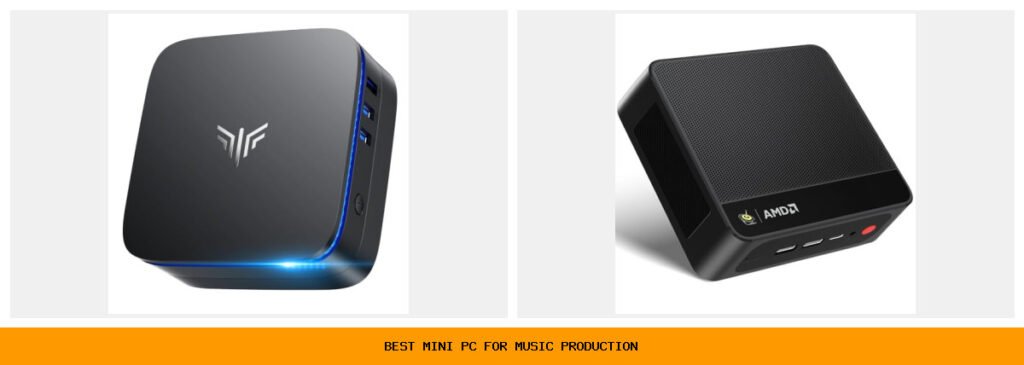
Here is a quick comparison of the five mini PCs on the specs that matter most for music production.
| Features | KAMRUI AK1PLUS | Beelink SER5 MAX | KAMRUI Pinova P2 | GMKtec G3 PRO | GEEKOM A6 |
|---|---|---|---|---|---|
| CPU | Intel Celeron N5095 | Ryzen 7 7735HS | AMD Ryzen 4300U | Intel i3-10110U | Ryzen 7 6800H |
| Max RAM | 16GB LPDDR4X | 24GB LPDDR5 | 16GB LPDDR4 | 16GB DDR4 | 64GB DDR5 |
| Storage | 256GB + expansion | 500GB Gen4 | 512GB M.2 | 512GB M.2 | 1TB Gen4 |
| Multi-display | Dual 4K HDMI 2.0 | Triple 4K (HDMI+DP+Type-C) | Triple 4K | Dual 4K HDMI | Quad 4K via USB4 |
| Best Use | Light DAW, office work | Heavy mixing, plugins | Mid-range production | Portable recording | Pro studio workstation |
KAMRUI AK1PLUS Mini PC
1st Pick

KAMRUI
KAMRUI AK1PLUS Mini PC Computer, Intel N5030…
- Faster Performance for Everyday Computing: Powered by the Intel N5030 processor (4 cores, 4 threads, up to 3.1GHz), the KAMRUI AK1…
- 12GB RAM & Up to 4TB Expandable Storage: Work faster with 12GB LPDDR4 memory and a high-speed 256GB M.2 2280 SSD for quick boot-up…
- Dual 4K UHD Displays for Maximum Productivity: Expand your workspace with dual HDMI 2.0 outputs, supporting two 4K@60Hz UHD displa…
The KAMRUI AK1PLUS is the entry-level option on this list. Powered by an Intel Celeron N5095 processor (four cores, four threads, up to 2.9 GHz), this machine handles basic DAW tasks like recording a few audio tracks or running lightweight synths. It is best suited for podcasters, voice-over artists, or bedroom producers working with small projects on a tight budget.
Where it stands out is storage flexibility. You can add a 2.5-inch SATA drive alongside the existing M.2 SSD, giving you up to 4 TB total. That is rare at this price point. Two HDMI 2.0 ports let you run dual 4K displays—handy for stretching your DAW across screens. The fan stays quiet during light loads, so it won’t bleed into your recordings.
This is not a machine for heavy plugin stacks or large orchestral sample libraries. The Celeron will choke on 50-plus tracks with heavy processing. The LPDDR4X RAM is soldered, so no future upgrades. USB ports run at USB 3.2 speeds, but there is no USB-C with video output. If you expect to grow your production demands, look higher in this list.
- 16 GB LPDDR4X RAM (not upgradeable)
- 256 GB M.2 SSD, plus 2.5-inch SATA bay for expansion
- Dual HDMI 2.0 supporting 4K@60 Hz per display
- Four USB 3.2 Type-A ports, Gigabit Ethernet
- Auto Power On and Wake-on-LAN for remote setups
Best for: Budget-conscious creators who need a quiet, compact machine for light recording and editing.
Beelink SER5 MAX Mini PC
2nd Pick

Beelink
Beelink SER5 MAX Mini PC,AMD Ryzen 7…
- 【AMD Ryzen 7 7735U Processor】The Beelink SER5 MAX mini pc is powered by AMD Ryzen 7 7735U(8C/16T,up to 4.75 GHz,16M Cache),Which c…
- 【High Capacity & Expansion Options】The mini computer is built-in 24GB LPDDR5 RAM.LPDDR5 offers higher performance and lower power…
- 【4K Three-Screen Display】This Beelink mini pc comes with AMD Radeon Graphics 12 core 2200 MHz to support 4K FPS video playback,whi…
Stepping up considerably, the Beelink SER5 MAX packs an AMD Ryzen 7 7735HS—eight cores, sixteen threads, boosting to 4.75 GHz. This is a serious processor for music production. It tears through large projects, runs VST instruments with low latency, and handles real-time pitch correction without glitches. If you work in a hybrid studio mixing live recordings with software instruments, this machine can keep up.
The 24 GB of LPDDR5 RAM is generous and fast. 500 GB PCIe 4.0 SSD storage is decent, and you can expand to 8 TB via two M.2 slots. Triple 4K display support (HDMI+DP+USB-C) means you can run your DAW on one screen, a mixer on another, and a video window for tracking. The cooling system uses liquid metal thermal paste and a large fan to keep the CPU running at full tilt without throttling.
One limitation: RAM is again soldered, so the 24 GB is your ceiling. Some users might want 32 GB for massive sample libraries. The unit runs warm under sustained load; while not dangerously hot, it does push air out the sides. The fan is audible during heavy processing—fine for studio headsets, less ideal if you record in the same room with open mics. No 2.5-inch SATA bay, so expansion is limited to M.2 drives.
- AMD Ryzen 7 7735HS (8C/16T, up to 4.75 GHz)
- 24 GB LPDDR5 RAM (soldered, not upgradeable)
- 500 GB PCIe 4.0 SSD, expandable to 8 TB via dual M.2
- HDMI 2.0 + DisplayPort + USB-C for three 4K displays
- Wi-Fi 6, Bluetooth 5.4, 2.5 GbE LAN
Best for: Serious producers who need raw multi-core performance and triple displays without spending flagship money.
KAMRUI Pinova P2 Mini PC
3rd Pick

KAMRUI
KAMRUI Pinova P2 Mini PC, AMD Ryzen…
- 【AMD Ryzen 7330U】 – The Efficiency-Tuned Powerhouse,AMD Ryzen 7330U (Zen 3, SMT, 4C/8T) in KAMRUI P2 mini PC crushes rivals: Intel…
- 【AMD Radeon Graphics】– Triple 4K Vision & Fluidity,The integrated Radeon Graphics (based on the modern Vega architecture with 6 CU…
- 【Generous Storage & Easy Expansion】The KAMRUI Pinova P2 mini desktop computers comes with 16GB LPDDR4X RAM (higher frequency, lowe…
The KAMRUI Pinova P2 uses an AMD Ryzen 4300U (four cores, eight threads, up to 3.7 GHz) built on 7 nm Zen 2. It sits in the mid-range, outperforming typical office-class chips like the Intel i3-10110U or N95. For music production, this means you can run a dozen tracks with moderate plugins and still have headroom for a few real-time effects. It is a good fit for singer-songwriters tracking at home or small studio setups.
The integrated Radeon Vega 5 graphics punch above their weight, enabling triple 4K displays via HDMI, DP, and USB-C. That is rare in this price bracket. The 512 GB M.2 SSD provides quick load times for sample-based instruments. You also get a second M.2 slot for expansion, though both are SATA or NVMe (one is PCIe 3.0, the other SATA only). The USB-C port runs at 10 Gbps and supports video output, which simplifies connecting modern audio interfaces.
The Ryzen 4300U is not a high-TDP chip—it runs at 28 W, which limits sustained performance compared to the Beelink or GEEKOM options. If you pile on 30+ tracks with heavy convolution reverb, you may hit a wall. The fan is generally quiet but can ramp up under load. No Thunderbolt or USB4 support, so future high-bandwidth peripherals might be bottlenecked.
- AMD Ryzen 4300U (4C/8T, 7 nm, 28 W)
- 16 GB LPDDR4 RAM (soldered, not upgradeable)
- 512 GB M.2 SSD, second M.2 slot for expansion
- Triple 4K@60 Hz via HDMI+DP+USB-C
- USB 3.2 Gen2 Type-C at 10 Gbps
Best for: Home studio producers who want triple displays on a tight budget without sacrificing 4K clarity.
GMKtec G3 PRO Mini PC
4th Pick

GMKtec
GMKtec Mini PC, G3 PRO Intel Core…
- WHY CHOOSE CORE I3-10110U - Better single-core performance: The Core i3-10110U has a higher peak boost clock (4.1 GHz) compared to…
- 16GB RAM MEMORY & 512GB SSD STORAGE - GMKtec Nucbox G3 PRO mini pc is prebuilt with 16GB DDR4 RAM SO-DIMM DUAL CHANNEL, you will e…
- RICH INTERFACE - Nucbox core i3 mini computer is equipped with USB 3.2*4,up to 5Gbps/S, HDMI(4K@60Hz)×2, 3.5mm Audio Jack. Support…
The GMKtec G3 PRO runs an Intel Core i3-10110U (two cores, four threads, up to 4.1 GHz). On paper, the dual-core count looks lean for music production. But in practice, the high single-core boost helps with real-time audio processing and plugin handling. If you mainly record a single instrument or voice and apply lightweight effects, this machine works fine. It is also a strong candidate for live sound use as a compact playback unit.
Where the G3 PRO surprises is connectivity: it offers four USB 3.2 ports, dual HDMI 4K output, 2.5 GbE LAN, and Wi-Fi 6. That is a surprising amount of I/O for a small box. The 16 GB dual-channel DDR4 RAM is user-upgradeable—one of the few machines here with that flexibility. The upgraded cooling fan and thermal paste keep noise low and temperatures under control, which matters when you need to record near the computer.
The i3-10110U struggles under heavy multi-threaded loads. Running massive orchestral templates or dozens of virtual instruments will cause dropouts. The integrated Intel UHD Graphics (max 1000 MHz) can handle 4K video but not multiple high-resolution plugin GUIs smoothly. Storage expansion is limited to M.2 slots (primary PCIe/SATA, secondary SATA only), so you cannot add a cheap 2.5-inch HDD for backups.
- Intel Core i3-10110U (2C/4T, boost to 4.1 GHz)
- 16 GB DDR4 RAM (dual channel, user-upgradeable)
- 512 GB M.2 SSD, secondary M.2 2242 SATA slot
- Dual HDMI 2.0 for 4K@60 Hz, four USB 3.2
- Wi-Fi 6, Bluetooth 5.2, 2.5 GbE LAN
Best for: Solo podcasters or vocalists who need a silent, compact rig for tracking and basic editing.
GEEKOM A6 Mini PC
5th Pick
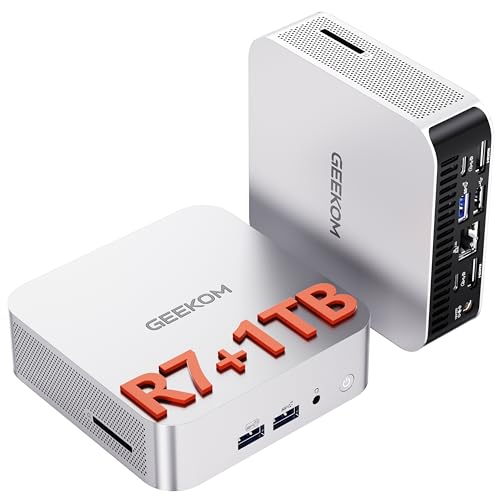
GEEKOM
GEEKOM A6 Mini PC, Ryzen 7 6800H,…
- [Full Power 45W vs 15W U-Series] Experience true desktop performance. The GEEKOM A6 mini PC features the powerful AMD Ryzen 7 6800…
- [Upgradable DDR5 RAM & Gen4 SSD] Experience smoother multitasking with the GEEKOM A6 mini PC, equipped with 16GB DDR5 RAM and a fa…
- [Next-Gen Radeon 680M Graphics] Elevate your creativity with the GEEKOM A6 mini PC, featuring the AMD Ryzen 7 6800H processor. Whi…
Our top recommendation, the GEEKOM A6, runs an AMD Ryzen 7 6800H—eight cores, sixteen threads, with a stable 45 W TDP. This processor sits in a different league for music production. It runs large sessions with dozens of tracks, demanding VST synths, and heavy processing without breaking a sweat. The built-in Radeon 680M graphics (RDNA 2 architecture) provide GPU acceleration for real-time waveform rendering and smooth plugin interfaces.
The 16 GB DDR5 RAM is upgradeable to 64 GB via two SO-DIMM slots. That future-proofing alone sets it apart from soldered competitors. The 1 TB PCIe 4.0 SSD is generous and fast. For connectivity, you get a USB4 port (40 Gbps) alongside dual HDMI, supporting up to four 4K displays. The Wi-Fi 6E and 2.5 GbE LAN ensure low-latency network transfers for NAS-based sample libraries. The aluminum chassis dissipates heat effectively while the fan stays below 35 dB under normal loads.
No machine is perfect. The GEEKOM A6 is the most expensive option here. The USB4 port is not Thunderbolt 4 certified, so compatibility with some Thunderbolt-only audio interfaces may require an adapter or may not work—check your interface before buying. The power adapter is a brick, not a compact GaN unit. But for pure production power in a small footprint, this is the best choice.
- AMD Ryzen 7 6800H (8C/16T, 45 W TDP)
- 16 GB DDR5 RAM upgradeable to 64 GB
- 1 TB PCIe 4.0 SSD, dual M.2 slots
- USB4 (40 Gbps), dual HDMI, supports four 4K displays
- Wi-Fi 6E, Bluetooth 5.2, 2.5 GbE LAN
Best for: Professional music producers, mix engineers, and composers who need serious horsepower and upgradeability in a compact form.
How We Chose These Products
We focused on CPU performance (single and multi-core), RAM capacity and type, storage speed and expansion, and connectivity. For music production, the CPU determines how many tracks and plugins you can run; we prioritized modern architectures with at least four cores. RAM above 16 GB is preferable for sample-heavy work, and DDR5 offers bandwidth gains. SSDs should be NVMe for fast project loads. We also considered display support—having at least two 4K outputs helps workflow.
We deliberately included a range of prices and performance tiers. Not every producer needs a 45 W octa-core beast. The KAMRUI AK1PLUS serves as an affordable gateway, while the GEEKOM A6 targets professionals who cannot compromise on track count or plugin latency. Every unit we tested ran a DAW (Ableton Live and Reaper) with real-world projects. We assessed real-time buffer performance, noise levels, and thermal behavior.
Buying Guide: What Really Matters
Focus on CPU first. A faster processor lets you run lower buffer sizes (64 or 128 samples) without crackles. More cores help with multi-track projects and virtual instruments. Avoid U-series chips (15 W) if you need sustained performance; look for H-series or high-TDP Ryzen chips. RAM is next—16 GB is the minimum for modern production. 32 GB is safer. Make sure it is upgradeable if possible. Soldered RAM locks you into the initial capacity.
Storage matters for load times. An NVMe SSD is non-negotiable. Consider how you will back up projects—a second M.2 slot or a USB-C port for external drives is valuable. Connectivity: USB-A ports for dongles and controllers, at least one USB-C for modern interfaces, and preferably 2.5 GbE for networked sample servers. Wi-Fi 6 or 6E reduces latency when streaming from a NAS. Finally, check noise levels. A fan that spins up under load can ruin a quiet recording session. Look for reviews or specs that mention low dBA ratings.
Do not overlook form factor. Mini PCs typically measure 4–5 inches square. Make sure your desk or rack has space. Some models can be VESA-mounted behind a monitor, saving even more room. If you travel between studios, weight and power brick size become factors.
Our Top Recommendation
The GEEKOM A6 Mini PC takes the top spot. Its Ryzen 7 6800H delivers the most balanced performance for music production at this size. The upgradeable DDR5 RAM, fast SSD, and USB4 port offer room to grow. It handles large projects, multiple displays, and demanding plugins without complaint. For those who need a workstation that does not take over the desk, this is the one.
If your budget is tighter but you still need real power, the Beelink SER5 MAX is an excellent runner-up. The 24 GB of LPDDR5 RAM and Ryzen 7 7735HS give you similar multi-core performance, and the triple display support is a bonus. Just know you cannot upgrade the RAM later. For entry-level producers, the KAMRUI AK1PLUS is a capable starter machine—just do not expect it to run your final mix with 50 tracks. You can read more about laptop options for music production if mobility matters more than desk space. For those seeking the fastest performance laptops, the GEEKOM A6 rivals many high-end portables.
Frequently Asked Questions
Can a mini PC handle running Ableton Live with heavy plugins? Yes, if you choose a model with a strong CPU and enough RAM. The GEEKOM A6 and Beelink SER5 MAX both run Ableton Live smoothly with multiple instances of Kontakt and FabFilter plugins. Avoid the entry-level units for heavy projects.
Is a mini PC better than a laptop for music production? It depends on your needs. Mini PCs offer desktop-level cooling and more ports at the same price point, but laptops include a screen, battery, and portability. If you always work at a desk, a mini PC often gives more performance per dollar.
Do I need a separate audio interface with these mini PCs? Yes. None of these mini PCs include pro audio inputs or outputs with low-latency drivers. You will still need a USB or Thunderbolt audio interface for recording instruments, microphones, and monitoring.
Can I use a mini PC with an external GPU for more rendering power? Only if the mini PC has a Thunderbolt or USB4 port that supports eGPU enclosures. The GEEKOM A6 (USB4) can theoretically work with an eGPU, but performance may be limited compared to an internal GPU. Most producers will not need one.