
How LLMs Work: A Simple Explanation
You paste a paragraph into ChatGPT and get back a perfectly structured email. You ask a coding assistant to fix a bug and it rewrites the whole function. The results feel like magic, but under the hood, every large language model does the same basic thing: it guesses the next word. Over and over again, billions of times.
That guess is not random. It’s the product of a mathematical system trained on a huge chunk of the internet. This article explains the full pipeline: the transformer architecture, how text becomes numbers, how training works, and why these models sometimes lie to you. You’ll walk away with a mental model solid enough to explain it to someone else.
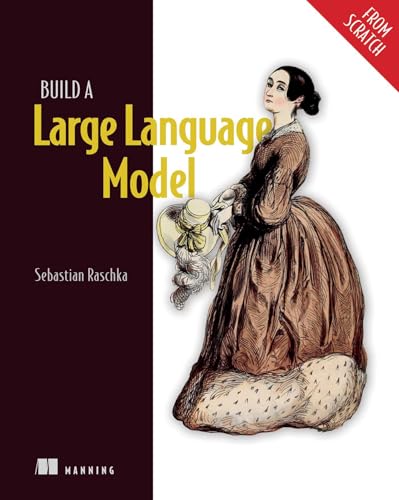
If you want to go deeper than an article, the book Build a Large Language Model (From Scratch) walks through building one layer by layer in code. It’s a hands-on way to see the math in action. Check the current price on Amazon if you’re interested.
What Is an LLM?
A large language model is a type of neural network trained to predict the next token in a sequence. The “large” refers to the number of parameters—the internal knobs the model adjusts during training. GPT-3 had 175 billion. Modern models push past a trillion.
All that size serves one purpose: storing patterns from training data. The model doesn’t have a database of facts. It has a statistical map of which words tend to follow which other words, built by reading text from books, Wikipedia, forums, and code repositories.
That distinction matters. When an LLM tells you the capital of France, it’s not looking it up. It’s generating the most probable continuation of the phrase “The capital of France is…” Usually that works. Sometimes it doesn’t.
The Transformer Architecture Explained
Before transformers, models like RNNs processed text one word at a time in order. That made them slow and prone to forgetting early words by the time they reached the end of a long sentence. The transformer, introduced in the 2026 paper “Attention Is All You Need,” changed the game.
Transformers process all tokens in parallel. The core innovation is the attention mechanism, which lets the model weigh how much each word in the input should influence every other word. When the model reads “The animal didn’t cross the street because it was tired,” attention helps it figure out that “it” refers to “animal,” not “street.”
The architecture has two main parts:
- Encoder: Reads the input and builds a rich representation of its meaning. Used in models like BERT.
- Decoder: Generates output one token at a time, using the encoder’s representation and everything it has already produced. GPT models are decoder-only.
Each layer in the transformer applies self-attention followed by a feed-forward network. Stack dozens of these layers—GPT-3 had 96—and the model can capture incredibly subtle linguistic patterns. The trade-off is compute. Training a large transformer costs millions of dollars in GPU time.
If you’re curious how similar parallel processing works at the hardware level, this multitasking guide explains how CPUs juggle multiple operations at once, which is conceptually related to how transformers handle many tokens simultaneously.
Tokenization: How LLMs Read Text
Models don’t see characters. They see tokens, which are chunks of text. A token can be a whole word like “apple,” a part of a word like “un” in “unbelievable,” or a single character like “z.”
Most modern models use Byte-Pair Encoding. The tokenizer starts with individual characters, then iteratively merges the most frequent adjacent pairs into new tokens. After training on a large corpus, it ends up with a vocabulary of 30,000 to 100,000 tokens. GPT-4 uses a vocabulary of about 100,000.
Tokenization has quirks. Common words get single tokens. Rare words get split into several. “ChatGPT” might be one token, while “ChatGPTs” could be three. This affects how the model understands text and how much context it can hold.
Token counts matter for pricing and performance. Most APIs charge per token, and a model’s context window is measured in tokens, not words. A rough rule: 100 tokens is about 75 English words.
Training Pipeline: From Pretraining to Fine-Tuning
Training an LLM happens in two distinct phases, and confusing them leads to a lot of misunderstanding.
Pretraining: Learning Language Itself
Pretraining uses self-supervised learning. The model is given massive amounts of raw text—often several terabytes—with no human labels. The task is simple: predict the next token. The model reads a sequence, guesses what comes next, checks the answer, and adjusts its parameters to reduce the error.
This is where almost all the compute goes. Training a 70-billion-parameter model can take months on thousands of GPUs. The result is a base model that understands grammar, facts, reasoning patterns, and even some code, but it’s not yet useful for conversation.
Fine-Tuning: Teaching It to Answer
Fine-tuning takes the pretrained base and trains it on smaller, curated datasets. For instruction-following models, that means pairs of prompts and ideal responses. For chat models, it means dialogue transcripts.
Reinforcement learning from human feedback (RLHF) is often the final step. Human raters rank the model’s outputs, and those rankings train a reward model that guides further optimization. This is what makes ChatGPT feel helpful rather than just predictive.
The distinction is practical. Fine-tuning a model on your company’s documents costs far less than pretraining. Open-source tools like LoRA let you fine-tune a 7-billion-parameter model on a single consumer GPU, whereas pretraining that same model would require a data center.
How Inference Works: Generating Text Step by Step
Inference is what happens when you type a prompt and hit enter. The model takes your input, tokenizes it, runs it through the transformer layers, and produces a probability distribution over every token in its vocabulary for what comes next.
Here’s the sequence:
- Your prompt gets tokenized into IDs.
- Each token becomes an embedding—a high-dimensional vector (often 4096 to 12288 dimensions) that captures meaning.
- The transformer layers process these embeddings, applying attention to build a contextual representation.
- A final layer projects the result to vocabulary size, producing a score for every token.
- A softmax function turns those scores into probabilities.
- The model picks a token based on those probabilities and the sampling strategy.
- That token gets appended to the input, and the process repeats.
This is called autoregressive generation. The model generates one token at a time, feeding each new token back into its own input. A 500-word answer requires 500 separate forward passes through the network. That’s why long responses take time.
The latent space is where the model’s learned representations live. Similar concepts cluster together, which is why you can do arithmetic with embeddings—”king” minus “man” plus “woman” lands near “queen.”
Sampling and Temperature: Controlling Creativity
The model outputs probabilities, not a single answer. How you pick from those probabilities determines whether the output is predictable or creative.
Temperature is the main dial. It scales the logits before softmax:
- Temperature near 0: The highest-probability token wins almost always. Output is deterministic and repetitive. Good for factual questions and code.
- Temperature around 0.7-1.0: A balanced mix. The model occasionally picks lower-probability tokens, producing varied but coherent text. Good for creative writing.
- Temperature above 1.0: The distribution flattens, making unlikely tokens much more probable. Output becomes chaotic and often nonsensical.
Another common parameter is top-p (nucleus sampling). Instead of considering all tokens, the model only samples from the smallest set whose cumulative probability exceeds p. Setting p to 0.9 means it ignores the long tail of very unlikely tokens, which reduces gibberish.
There’s a trade-off. Lower temperature reduces hallucinations but makes the model sound robotic. Higher temperature produces more interesting prose but increases errors. For most practical uses, temperature between 0.2 and 0.7 is the sweet spot.
Why LLMs Hallucinate and How to Mitigate It
Hallucinations happen when the model generates text that’s fluent but wrong. The cause is baked into the architecture: the model is optimized to produce plausible continuations, not true statements. It has no ground truth to check against.
Several factors increase hallucination rates:
- Questions outside the training data distribution
- Ambiguous prompts that could lead many directions
- High temperature settings
- Requesting citations or specific numbers the model never stored precisely
You can reduce hallucinations with prompt engineering. Ask the model to reason step by step, which gives it more intermediate tokens to work with. Tell it to say “I don’t know” when uncertain. Ask it to quote from provided source documents rather than rely on memory.
Retrieval-augmented generation (RAG) is the more robust fix. You fetch relevant documents from your own database, stuff them into the context window, and ask the model to answer based on that text. This grounds the model in verifiable sources and dramatically cuts hallucination rates.
Even with these techniques, you should treat LLM outputs as drafts, not final answers. For critical decisions, verify against primary sources.
Context Windows and Their Limitations
The context window is the maximum number of tokens the model can consider at once. Early models handled 2,048 tokens—about 1,500 words. Modern models range from 32,000 to 200,000 tokens. Some claim a million.
Longer context sounds strictly better, but there are real costs. Attention scales quadratically with sequence length, so a 128,000-token context requires far more compute per token than an 8,000-token one. Latency goes up, and the cost per request rises.
More importantly, models don’t use long contexts well. Research shows attention becomes diffuse beyond a few thousand tokens—the model “forgets” early parts of a long document. Retrieval systems that pull only the most relevant chunks often outperform dumping everything into the prompt.
For long conversations, you’ll need to manage context yourself. Summarize older messages, trim irrelevant details, and keep the most important instructions near the end of the prompt, where attention is strongest.
Open-Source vs. Closed-Source LLMs
The LLM landscape splits into two camps, and the choice matters for developers and businesses.
Closed models like GPT-4 and Claude offer the best raw performance, polished APIs, and heavy investment in safety. You trade away control: you can’t inspect weights, you’re subject to API pricing, and your data passes through a third party’s servers.
Open models like Llama 3, Mistral, and Qwen let you download weights and run them on your own hardware. You get privacy, unlimited inference, and the freedom to fine-tune. The catch is that you need the infrastructure to serve them, and they often lag behind the frontier models on complex reasoning.
| Factor | Closed-Source (GPT-4, Claude) | Open-Source (Llama 3, Mistral) |
|---|---|---|
| Raw capability | Generally highest | Close, improving rapidly |
| Cost per token | Predictable API pricing | Hardware + electricity, fixed |
| Data privacy | Limited by provider policy | Full control |
| Customization | Limited to API parameters | Full fine-tuning access |
| Deployment | Nothing to manage | Requires GPU infrastructure |
| Offline use | Impossible | Possible |
For a quick experiment, closed APIs win. For production systems handling sensitive data, open models are often the only compliant option. The gap between them narrows every few months.
Real-World Applications and Use Cases
LLMs have moved past chatbots. Here’s where they deliver measurable value today:
- Code generation and review: Tools like GitHub Copilot autocomplete code, generate tests, and explain unfamiliar codebases. They’re not perfect, but they catch boilerplate-level work.
- Search and summarization: RAG systems index internal documents and answer questions with citations. Legal and medical teams use this to review thousands of pages quickly.
- Translation and localization: LLMs handle idioms and context better than older statistical systems, though they still need human review for critical content.
- Data extraction: Feeding unstructured text—emails, invoices, reports—and getting structured JSON out. This is one of the most reliable use cases.
- Education and tutoring: Models explain concepts at any level, generate practice problems, and give feedback on writing.
The common thread is that LLMs excel at tasks with clear inputs and acceptable error rates. They struggle where mistakes are costly and where they must reason about the real world in real time.
Benchmarking and Evaluating LLM Performance
You can’t judge a model by reading its marketing page. Benchmarks exist to measure specific capabilities:
- MMLU: Multiple-choice questions across 57 subjects. Tests broad knowledge and reasoning.
- HumanEval: Python code generation from docstrings. Measures coding ability.
- GSM8K: Grade-school math problems. Tests multi-step reasoning.
- TruthfulQA: Adversarial questions designed to trigger false answers. Measures hallucination resistance.
Benchmarks have a shelf life. Models train on benchmark data, so scores inflate over time. A model that scores 90% on MMLU might still fail at simple real-world tasks the benchmark never covers.
For your own use, build a private evaluation set. Take 50 representative prompts from your actual workload, run them through candidate models, and score the outputs yourself. This beats any public leaderboard for predicting real-world performance.
Future Directions: Multimodal and Agentic LLMs
Two trends dominate the next wave. Multimodal models accept images, audio, and video alongside text. GPT-4V and Gemini already process images, and the quality is improving fast. The architecture is similar—each modality gets its own encoder, and the transformer fuses the representations.
Agentic LLMs go beyond generating text. They use tools, browse the web, run code, and take actions based on the results. Instead of one-shot answers, they plan a sequence of steps, execute them, and iterate. This is where the real productivity gains will come from.
Both directions increase the compute required per query. A model that browses 20 pages to answer one question costs more than a model that answers from memory. The economics will shape how these systems get deployed.
If you’re building systems that depend on LLM output, you’ll also care about how the underlying hardware schedules these heavy workloads. This CPU scheduling explainer gives useful background on how computational resources get managed.
Frequently Asked Questions
How does a large language model actually generate text?
It predicts the next token in a sequence, one at a time. Your prompt is tokenized, passed through transformer layers, and converted into a probability distribution over the vocabulary. A sampling strategy picks a token, that token joins the input, and the process repeats until the model produces a stop token.
What is the role of tokenization in LLMs?
Tokenization converts raw text into integer IDs the model can process. It uses Byte-Pair Encoding to create a vocabulary of common subword units. This reduces the vocabulary size compared to character-level processing and handles rare words gracefully by splitting them into known pieces.
Why do LLMs sometimes produce incorrect or nonsensical answers?
They optimize for plausible text, not truth. The model has no access to external facts during inference, so it relies on statistical patterns from training data. High temperature, ambiguous prompts, and questions outside its training distribution all increase the chance of nonsense.
What is the difference between pretraining and fine-tuning?
Pretraining teaches the model language structure using self-supervised next-token prediction on massive raw text. Fine-tuning adapts that base model to specific tasks using curated, labeled datasets and often RLHF. Pretraining costs millions; fine-tuning can cost hundreds.
How does the transformer architecture improve on earlier models?
Transformers process all tokens in parallel and use self-attention to weigh relationships between any pair of tokens directly. Earlier RNNs processed sequentially and suffered from vanishing gradients over long sequences. Transformers handle long-range dependencies far better and train much faster on modern hardware.
What is temperature and how does it affect LLM output?
Temperature scales the logits before the softmax. Low values (near 0) make the highest-probability token dominate, producing deterministic output. High values (above 1) flatten the distribution, making output more random and creative. Use low for facts, high for fiction.
How do LLMs handle long documents or conversations?
They can take a fixed-size context window of tokens as input. But attention becomes diffuse over very long sequences, so models effectively “forget” early content. Practical approaches include summarizing old messages, using retrieval to pull relevant chunks, and keeping critical instructions near the end.
What are the main limitations of current LLMs?
Hallucinations, no real-time learning, quadratic compute scaling with context length, and inability to reason about the physical world. They also carry biases from training data and can be manipulated with adversarial prompts.
How do open-source LLMs compare to proprietary ones?
Proprietary models lead on raw capability and offer managed APIs. Open models give you data privacy, full customization, and no per-token fees, but require GPU infrastructure and often trail on complex reasoning tasks. The gap is closing quickly with each new release cycle.
What to Remember When Using LLMs
- An LLM is a next-token predictor, not a database or a reasoning engine. Treat every output as a hypothesis, not a fact.
- Lower temperature (0.1-0.3) for factual tasks, higher (0.7-1.0) for creative writing. Adjust per use case.
- Use retrieval-augmented generation to ground answers in your own documents and cut hallucinations.
- Manage context windows actively. Summarize, trim, and reorder prompts for long conversations.
- Fine-tuning beats prompt engineering when you need consistent style or domain-specific behavior.
- Evaluate models on your own private test set, not just public benchmarks.
- Open-source models are viable for production when privacy or cost matters, especially with 7B-13B parameter sizes.