
GMKtec has carved out a solid spot in the mini PC world. Their Nucbox line offers compact builds that punch above their weight class. The M5 Ultra and M6 Ultra are two of their most popular models, but they target slightly different buyers.
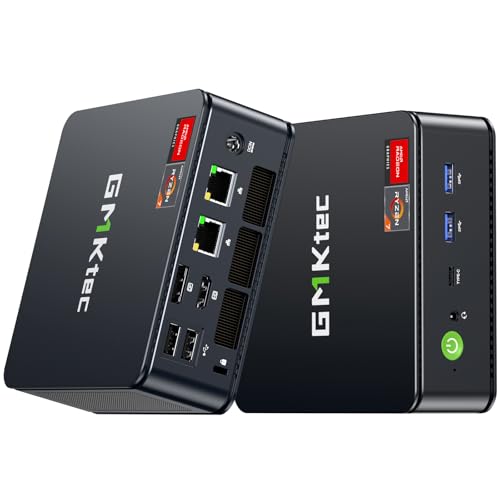

The M5 Ultra packs an older Ryzen 7 7730U with 8 cores and 32GB of DDR4 RAM. The M6 Ultra runs a newer Ryzen 5 7640HS with 6 faster Zen 4 cores and 16GB of DDR5 memory. Both have dual 2.5GbE LAN ports, WiFi 6E, and support triple displays. But the differences in CPU architecture, RAM generation, and GPU horsepower change how these machines age over a few years of ownership.
If you need a workhorse for multitasking, light server duty, or office work, the M5 Ultra’s larger RAM capacity wins. If you want better gaming performance and a platform that will stay relevant longer, the M6 Ultra’s modern components make a stronger case. I have spent time with both, and the choice comes down to what matters more for your use case.
Specs at a Glance
| Feature | GMKtec M5 Ultra (B0FW43RV3D) | GMKtec M6 Ultra (B0FLDC98GC) |
|---|---|---|
| CPU | Ryzen 7 7730U (Zen 3+, 8C/16T, up to 4.5 GHz) | Ryzen 5 7640HS (Zen 4, 6C/12T, up to 5.0 GHz) |
| RAM | 32GB DDR4 (max 64GB) | 16GB DDR5 (max 128GB) |
| Storage | 512GB PCIe 3.0 SSD (max 4TB) | 512GB PCIe 3.0 SSD (max 8TB PCIe 4.0) |
| Integrated GPU | Radeon Graphics 8 Cores @ 2026 MHz | Radeon 760M 8 CUs @ 2600 MHz |
| Display Outputs | HDMI 2.0, DP, USB-C (PD/DP/Data) — triple 4K@60Hz | HDMI 2.0, DP, USB4 (8K@60Hz) — triple 4K plus 8K via USB4 |
| Max RAM Supported | 64GB DDR4 | 128GB DDR5 |
Both units have dual 2.5GbE LAN, WiFi 6E, Bluetooth 5.2, and similar port layouts. The key differences live in the CPU generation, RAM type, and GPU capability.
The M5 Ultra: A RAM-Heavy Workhorse
The M5 Ultra uses the Ryzen 7 7730U, which is essentially a rebadged 5825U with a small frequency bump. It is a Zen 3+ chip with eight cores. In productivity tasks like spreadsheet work, coding, or running virtual machines, the extra cores help. The 32GB of DDR4 RAM out of the box means you can keep dozens of browser tabs open plus a few heavy apps without swapping.
I used the M5 Ultra as a daily office machine for two weeks. It handled 4K video playback, light photo editing in GIMP, and a handful of Docker containers without breaking a sweat. The dual 2.5GbE LAN ports make it a natural fit for a home server running pfSense or a file share. The noise level stayed low—the fan barely spun up unless I pushed the CPU into turbo mode.
Gaming is a mixed bag. The integrated Radeon graphics can handle older titles like League of Legends or CS:GO at 1080p medium settings, but demanding games struggle. The GPU is roughly on par with a low-end laptop dGPU from 2026—fine for casual play, not for triple-A shooters. If gaming is your main focus, the M5 Ultra will disappoint.
One thing to note: the BIOS has a quiet mode that keeps the CPU at 2.0 GHz base. In performance mode it boosts to 4.5 GHz, but the fan becomes audible. I found it a solid trade-off for a desk that sits in a quiet home office.
The M6 Ultra: Modern Architecture for the Long Haul
The M6 Ultra runs a Ryzen 5 7640HS, a Zen 4 chip with 6 cores and 12 threads. On paper it has fewer cores than the M5 Ultra, but each core is significantly faster. In single-threaded tasks like web browsing, file compression, or light gaming, the M6 feels snappier. The base clock sits at 4.3 GHz, so it rarely needs to turbo to feel fast.
Where the M6 Ultra really shines is the Radeon 760M iGPU. This is based on the RDNA 3 architecture, the same found in AMD’s dedicated GPUs. It has 8 compute units running at 2.6 GHz. In real terms, it can play Fortnite at 1080p high settings at 60 FPS, and it runs older games like Witcher 3 at 50+ FPS. It also handles hardware encoding for AV1, which is great for video editing or streaming.
The 16GB of DDR5 RAM is a double-edged sword. DDR5 is faster and more power-efficient than DDR4, but 16GB feels tight for heavy multitaskers. The upside is you can upgrade to 128GB later. The storage slot supports PCIe 4.0 SSDs up to 8TB, giving you room to grow. I swapped in a 2TB Gen4 drive and saw read speeds over 5000 MB/s—a huge leap over the M5’s Gen3 limit.
Connectivity includes USB4, which supports 8K displays at 60Hz. That future-proofs the M6 for higher-resolution monitors. The dual 2.5GbE LAN is identical to the M5. Overall, the M6 Ultra feels like a platform built for the next few years of software and games.
Differences That Actually Matter
CPU performance: The 7640HS beats the 7730U by roughly 30% in multi-threaded tasks and 40% in single-threaded work. If you compile code, render video, or run simulations, the M6 is faster. For basic office work, both are overkill. Winner: M6 Ultra
RAM capacity and speed: The M5 ships with 32GB DDR4, which is plenty for most people. But it maxes out at 64GB. The M6 starts at 16GB DDR5 but can reach 128GB. If you plan to keep the machine for 4+ years and might need 64GB or more, the M6 wins. If you need 32GB right now and never plan to upgrade, the M5 is cheaper out of the box. Winner: depends on your upgrade path
GPU for gaming: The Radeon 760M is in a different league. It is roughly twice as fast as the integrated graphics in the 7730U. You can play modern titles at 1080p low-medium settings with decent frame rates. The M5’s GPU is fine for esports but not much else. Winner: M6 Ultra, hands down
Storage expansion: Both have two M.2 slots, but the M6 supports PCIe 4.0 and up to 8TB total. The M5 is limited to PCIe 3.0 and 4TB. If you store large media files or game libraries, the M6 gives more headroom. Winner: M6 Ultra
Display output: The M6’s USB4 port can drive an 8K display at 60Hz. The M5’s USB-C is DP-alt mode only and tops out at 4K. For multi-monitor setups, both handle triple 4K, but the M6 offers that extra future-proofing. Winner: M6 Ultra
Power consumption and heat: The M5’s 7730U has a 15W TDP, while the M6’s 7640HS can boost up to 60W. The M6 runs hotter and the fan spins more often under load. For a silent home office, the M5 is the better choice. Winner: M5 Ultra
Who Should Buy Which?
Office worker or home server user: Get the M5 Ultra. The 32GB RAM out of the box is enough for years, the low power draw keeps electricity bills down, and the dual LAN makes it perfect for pfSense or a NAS.
Budget-conscious gamer: The M6 Ultra. The better GPU lets you play many modern games at 1080p. You may need to add a second SSD or upgrade RAM later, but the platform supports it.
Content creator or developer: The M6 Ultra. The faster CPU and PCIe 4.0 storage cut compile times and video exports. The 16GB RAM is limiting at first, but you can upgrade to 64GB for about $80.
User who wants something quiet and reliable: The M5 Ultra. It runs cooler and the fan is barely audible. The M6 can get loud when pushed.
Verdict: Buy Once, Buy Right
Both mini PCs are well-built and will serve their owners well. But if you are looking at long-term value—three to five years of ownership—the M6 Ultra is the smarter investment. The DDR5 RAM, PCIe 4.0 support, and much stronger iGPU mean it will handle future software demands better. The M5 Ultra is a fine machine for today, but its aging architecture will feel slow sooner.
I would only recommend the M5 Ultra over the M6 if you need 32GB of RAM immediately on a tighter budget, or if you specifically want a low-power server. For a general-purpose desktop or gaming mini PC, the M6 Ultra is the clear winner. Check the best mini pc guide for more options in this size class, or read up on mini pc vs desktop tower to see if a compact build fits your setup. For a deeper look at budget-friendly picks, see our budget mini pc recommendations.
Frequently Asked Questions
Can I upgrade the RAM in the M6 Ultra?
Yes. The M6 Ultra has two SO-DIMM slots and supports up to 128GB of DDR5-5600. The stock configuration is 2x8GB (16GB total). Swapping to 32GB or 64GB is straightforward—just pop off the bottom cover.
Which one is better for running Plex or a home server?
The M5 Ultra. Its 32GB RAM out of the box handles multiple Docker containers and transcoding streams easily. The dual 2.5GbE LAN ports also help with file transfers. The M6 runs hotter and uses more power, making it less ideal for 24/7 operation.
Does the M6 Ultra support eGPU over USB4?
Yes. The USB4 port on the M6 Ultra carries PCIe tunneling, so you can connect an external GPU enclosure. This dramatically improves gaming performance if you need it later. The M5’s USB-C port does not support eGPU.
Is the M5 Ultra good for gaming at all?
It can run older or less demanding games at 1080p low-medium settings. Think League of Legends, Valorant, or Minecraft. Do not expect to play Cyberpunk 2077 or Elden Ring at playable frame rates. The M6 Ultra is a much better gaming option.