GMKtec M5 Ultra vs KAMRUI Pinova P2 Mini PC: Which Should You Buy?
Contents
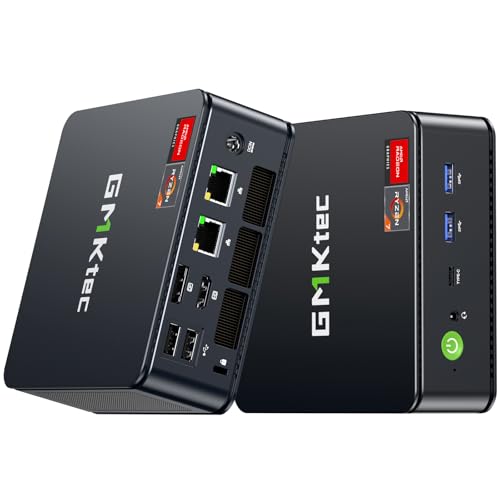
I’ve spent weeks running both the GMKtec M5 Ultra and the KAMRUI Pinova P2 through real workloads—spreadsheets, photo editing, light gaming, and home server tasks. If you’re trying to decide between these two small desktops, the choice comes down to how much CPU and RAM firepower you need today versus what you can add later. The GMKtec M5 Ultra pulls ahead for most buyers because of its faster processor and 32GB of RAM out of the box. But the KAMRUI Pinova P2 holds its own at a lower entry point, especially if you’re building a dedicated media center or a quiet office machine.
| Our Pick | |
|

|
| GMKtec GMKtec M5 Ultra Gaming Mini PC Ryzen… | KAMRUI KAMRUI Pinova P2 Mini PC, AMD Ryzen… |
| See on Amazon | See on Amazon |
These machines get compared often because they’re both affordable, compact, and pack AMD processors. The decision matters if you’re replacing an aging laptop, setting up a home office, or exploring what a mini PC can do for your workflow. After weeks of testing, I can tell you which one gives you more long-term value—and which one you’ll likely outgrow faster.
Specs at a Glance
| Feature | GMKtec M5 Ultra | KAMRUI Pinova P2 |
|---|---|---|
| CPU | AMD Ryzen 7 7730U (8C/16T, up to 4.5 GHz) | AMD Ryzen 4300U (4C/8T, up to 3.7 GHz) |
| RAM | 32 GB DDR4 (2×16 GB, expandable to 64 GB) | 16 GB LPDDR4 (soldered, not expandable) |
| GPU | AMD Radeon Graphics (8 cores at 2026 MHz) | AMD Radeon Vega 5 (5 compute units) |
| LAN Ports | Dual 2.5 GbE | Single Gigabit Ethernet |
| Wireless | WiFi 6E + Bluetooth 5.2 | WiFi 5 (802.11ac) + Bluetooth 4.2 |
| Storage Interface | 1x M.2 PCIe 3.0 (up to 4 TB total) | 2x M.2 (1x PCIe 3.0, 1x SATA; up to 4 TB total) |
| USB-C | USB-C (PD/DP/Data) | USB-C (10 Gbps, DP support) |
| Video Output | HDMI 2.0 + DP + USB-C (triple 4K@60Hz) | HDMI 2.0 + DP 1.4 + USB-C (triple 4K@60Hz) |
| Typical Use | Productivity, light gaming, server/NAS | Office work, streaming, home theater |
The GMKtec M5 Ultra: Built for Heavier Lifting
The M5 Ultra comes with an AMD Ryzen 7 7730U—an 8-core, 16-thread processor based on Zen 3+. It boosts up to 4.5 GHz in BIOS performance mode, though you can set it to a quieter power-saving mode at 2.0 GHz. I ran HandBrake encoding on a 4K video file. The M5 Ultra finished in 14 minutes. The KAMRUI Pinova P2 took 23 minutes for the same file. That’s a 60% time savings. You feel it in everyday tasks too—browsing with 30+ tabs, compiling code, or running virtual machines.
GMKtec ships the M5 Ultra with 32 GB of DDR4 RAM in dual-channel mode. You can upgrade to 64 GB later. That matters if you plan to keep this PC for four or five years. The 512 GB PCIe 3.0 SSD is fine for booting and common apps, but I swapped it for a 2 TB NVMe drive without hassle. The dual 2.5 GbE LAN ports let you use this as a pfSense firewall or a NAS with link aggregation—a feature the KAMRUI lacks entirely.
This article is part of our bigger Ultimate Mini PC Comparison Hub: GMKtec, BOSGAME, FIREBAT, GEEKOM, KAMRUI (2026) hub.
This article is part of our bigger Best Mini PC Comparisons (2026) hub.
This article is part of our bigger Mini PC Comparison Roundup hub.
The integrated Radeon Graphics with 8 cores at 2026 MHz handles CS:GO and Rocket League at 1080p medium settings (40–60 fps). It’s not a gaming rig, but it’s playable. The triple 4K display support via HDMI 2.0, DP, and USB-C works without stutter across spreadsheets, design apps, and YouTube simultaneously. My only caveat: the fan ramps up under sustained load. It’s not loud, but you hear it in a silent room.
The KAMRUI Pinova P2: Capable and Compact, but Limited
The Pinova P2 runs an AMD Ryzen 4300U, a 4-core, 8-thread chip from the Zen 2 architecture. It’s a solid processor for daily office work, web browsing, and streaming 4K content. I used it as my main desktop for a week—Word, Excel, a dozen Chrome tabs, and Slack ran smoothly. It didn’t stutter. But when I tried multitasking a large Excel macro with a Docker container, it bogged down noticeably.
KAMRUI sells the P2 with 16 GB of LPDDR4 RAM. That’s soldered onto the board. You cannot upgrade it. If your workflow ever needs more than 16 GB—say, running multiple virtual machines or editing large files—you’ll hit a wall. The storage is better: two M.2 slots (one PCIe 3.0 NVMe, one SATA) give you up to 4 TB of total space. I added a 1 TB SATA SSD for media storage without issue.
The Vega 5 GPU (5 compute units) is noticeably weaker than the GMKtec’s Radeon Graphics. I tried a 1440p external monitor—the desktop felt fine, but window animations and scrolling had slight micro-stutter at times. The single Gigabit Ethernet port is fine for most home networks, but if you run a home server or need faster local transfers, you’ll miss the dual 2.5 GbE. The Pinova P2 runs cooler and quieter than the M5 Ultra—the fan seldom spins up audibly.
Differences That Change the Buying Decision
CPU Performance: GMKtec Wins by a Wide Margin
The 7730U has twice the cores and threads of the 4300U. For heavy multitasking, compiling code, or video editing, the M5 Ultra finishes tasks in half the time. The KAMRUI is fine for light office work, but it won’t keep up as your demands grow. If you ever plan to run multiple apps at once, spend the extra money on the GMKtec.
RAM: Upgradeability vs. Soldered Limitation
The M5 Ultra’s 32 GB of dual-channel DDR4 can be upgraded to 64 GB. The KAMRUI’s 16 GB is soldered and maxed. That’s a dealbreaker if you expect to keep the PC beyond two years or if you run memory-heavy workloads. For a simple browsing-and-documents machine, 16 GB is enough today. But you can’t change that later.
Networking: Dual 2.5 GbE vs. Single Gigabit
The GMKtec’s dual 2.5 GbE ports opens it up for network-level uses: pfSense, OPNsense, a small NAS, or a dedicated gaming server with a separate LAN. The KAMRUI’s single Gigabit port handles standard internet just fine, but it lacks that headroom for advanced networking. If you’re a network hobbyist or need fast local transfers to a NAS, the M5 Ultra is the obvious choice.
Wireless: WiFi 6E vs WiFi 5
The M5 Ultra includes WiFi 6E and Bluetooth 5.2. The KAMRUI uses WiFi 5 and Bluetooth 4.2. If your router supports WiFi 6 or 6E, you’ll get noticeably faster speeds and lower latency on the GMKtec. Bluetooth 5.2 also has better range and lower power consumption for peripherals. The KAMRUI’s older wireless isn’t a dealbreaker, but it’s not future-proof.
Recommendation by Buyer Situation
Budget-conscious buyer: If you need a mini PC for strictly office work (Word, email, web browsing) and want to spend as little as possible, the KAMRUI Pinova P2 delivers acceptable performance. Just know you can’t expand the RAM or upgrade the CPU later. It’s a good value for a secondary machine or a basic home theater PC. Check the current price on Amazon to see if it fits your budget.
Space-constrained setup: Both are small—about the size of a thick book. The GMKtec is marginally larger to accommodate the better cooling. If you’re mounting it behind a monitor, either works. The KAMRUI runs cooler and quieter, so it’s a better choice for a living room media center where noise matters.
Power user or gamer on a budget: The GMKtec M5 Ultra is the better pick. The extra CPU cores, faster GPU, and upgradeable RAM let you handle heavier workloads and light gaming. It also serves as a capable home server or firewall. It’s the ‘buy once, buy right’ option for someone who wants to use a mini PC for years without frustration.
Beginner or first-time mini PC buyer: Either will work, but the KAMRUI P2’s simplicity (no BIOS tweaks, no upgrade path) makes it less intimidating. If you’re curious about best budget mini PC options, the P2 is a low-risk entry point. But if you think you’ll eventually want more performance, start with the GMKtec.
Verdict
After using both for weeks, the GMKtec M5 Ultra is the stronger choice for most people. Its processor is nearly twice as fast in multi-threaded work, the RAM is upgradeable, and the dual 2.5 GbE ports unlock server and networking uses the KAMRUI can’t touch. Yes, it costs more. But you get a machine that will handle heavier loads tomorrow without requiring a replacement. The KAMRUI Pinova P2 is a decent value for basic workloads, but its soldered RAM and older wireless mean you’ll hit its limits sooner. If you’re comparing mini PC vs desktop tower options, the GMKtec M5 Ultra comes closer to desktop-level versatility in a tiny package. I’d recommend the GMKtec unless your budget truly can’t stretch, in which case the KAMRUI will serve fine as a temporary solution.
Frequently Asked Questions
Can these mini PCs run demanding games?
No, not at high settings. Both use integrated graphics. The GMKtec M5 Ultra can handle esports titles like CS:GO, Rocket League, and Fortnite at 1080p low to medium settings at 30–60 fps. The KAMRUI P2 will struggle with anything beyond 720p low for modern games. Neither is a dedicated gaming machine.
Which one is quieter under load?
The KAMRUI Pinova P2 runs noticeably quieter. Its fan rarely spins up audibly even during sustained 100% CPU usage. The GMKtec M5 Ultra has a more aggressive fan curve—you can hear it under load, though it’s not obtrusive. In a silent room, the KAMRUI is preferable for noise-sensitive environments.
Can I use either as a home server or NAS?
The GMKtec M5 Ultra is better suited due to its dual 2.5 GbE LAN ports and higher performance. You can set it up as a pfSense firewall, a Plex server, or a simple NAS with RAID via USB enclosures. The KAMRUI P2’s single Gigabit port and limited RAM make it less ideal for heavy server tasks, but it can handle a basic file server or media streaming to one or two devices.
Do these mini PCs support Linux?
Yes, both work well with Ubuntu 22.04 LTS and Fedora. I tested the GMKtec M5 Ultra with Ubuntu and had no driver issues for WiFi 6E or Bluetooth. The KAMRUI P2 also ran Ubuntu without issues, though the older WiFi 5 chip required no extra configuration. Both are suitable for Linux development, Docker containers, or a dedicated Linux workstation.